#40: How I am using Claude Code as a non-coder
This is the closest I have come to "feeling the AGI"
I suspect there would be a sharp division in the debate on AI between those who have used Claude Code and those who have not. I use the term loosely here, as a placeholder for any frontier agentic coding tool.
For a non-techie, I have been following the post-LLM era of AI fairly closely and have always been more bullish on AI than the average person. Overall, however, I have been somewhat tempered compared to fans, which is probably in the same space as Arvind Narayanan-Sayash Kapoor level of excitement. Which is to say that the current progress is very impressive; I see lots of potential, but I am not completely awed by it as if it were the ‘god machine.’
At a conceptual level, I am still broadly in the same place, but my sense of awe has considerably increased after playing around with Claude Code over the last two weeks. It is the most AGI-like thing I have ever experienced.
So far, I have been occasionally impressed with chatbots. I have tried various prompting techniques and most fads. But the results often lacked something. Mostly, it did not have a great sense of which details are important and reliable. And the writing is always too… AI-like. For better or worse, I have developed a very strong sense of AI-generated prose, and I am irrationally repulsed by it.
But I feel differently after using Claude Code. Most of the time, it can actually pick up on the essence of what I want; it goes on for hours sometimes; it tries, fails, and troubleshoots problems on its own. I do not know much about coding beyond some data analysis for policy research. Yet, I have often been able to get what I want.
Here are some random projects I have worked on in the last two weeks or so.
1. Dino internet race
This was completely Simran Saini’s idea, which I worked with Claude Code to execute. During video calls, whenever there is lag, I jokingly tell my friend(s) on the side to fix their internet. And they would retort with something along the lines of “actually, it’s your network that sucks.” This is all just a nonsensical talk-and-forget type of conversation.
Dino Race allows you to settle that dumb debate by ‘racing’ against your friends (up to six people) live, where your dinosaur avatar runs as fast as the speed and stability of your internet. The person with the best internet wins. It is purely for fun, and you can try playing it here.
Also, here is the GitHub repo.
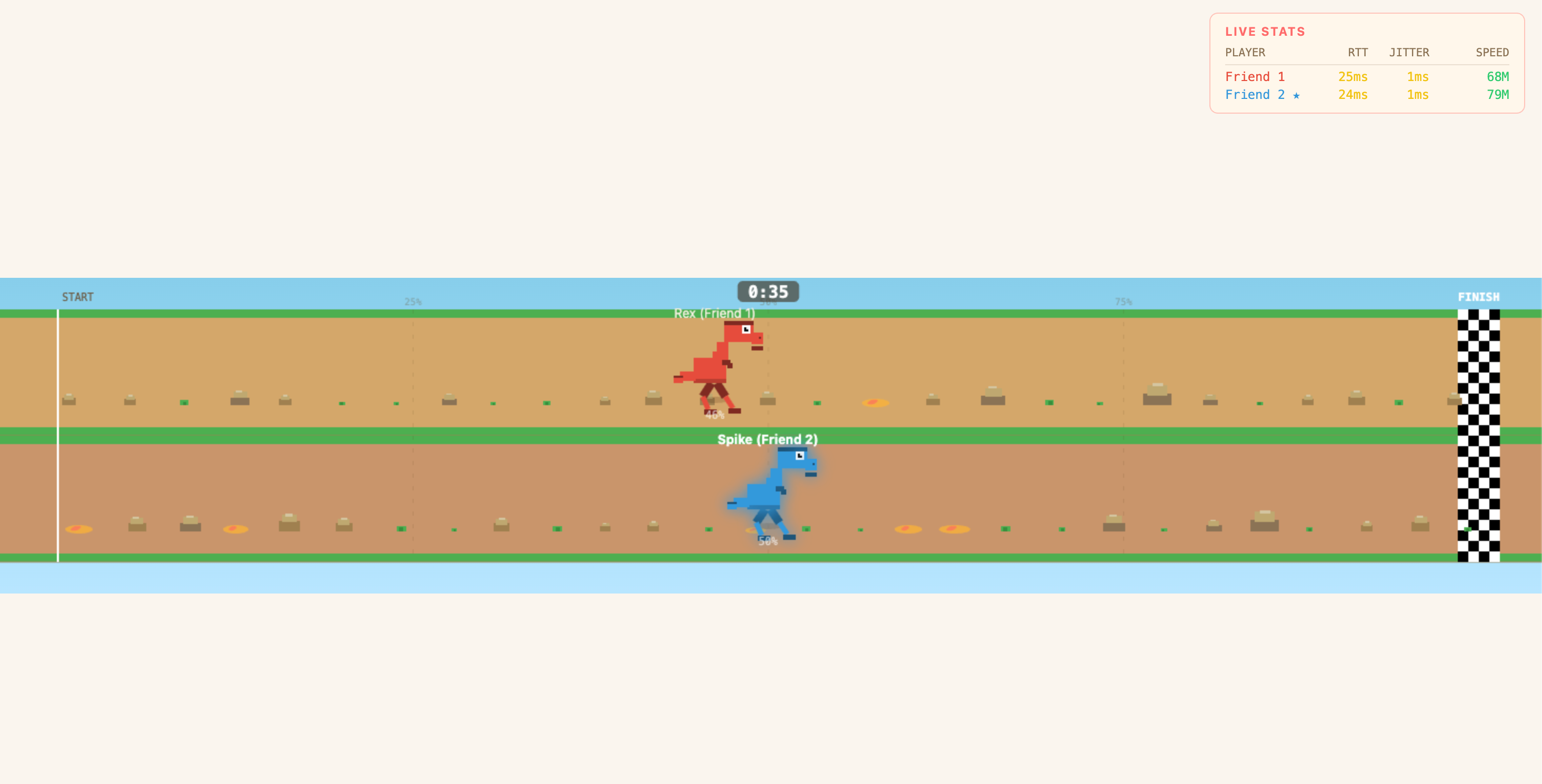
I am not aware of anything similar to this. Claude Code completely built it from scratch. The URL is a little strange because it is a free subdomain. My personal Raspberry Pi acts as the game server. Having a home server gives me a strange kind of cheap thrill.
But why do I own a RasPi in the first place? This brings me to the next project.
2. WhatsApp message scheduler
Sometimes I want to reply to people, but the timing feels odd. These are usually semi-professional messages, and the recipient is in a different time zone, or I checked the messages too late at night. Often, I just want to schedule messages in advance.
There is no way to schedule messages on WhatsApp natively, and I hate using third-party integrations with my personal communication apps. So, Claude Code helped me build a scheduler. I had to log in to my WhatsApp Web once, and a script operates a headless browser.
The obvious problem was that my PC needed to be active when a scheduled message was supposed to be sent. That was impractical, so I bought a Raspberry Pi 5. It is a low-power single-board PC that I had been considering buying for some time, but had no obvious use case until then.
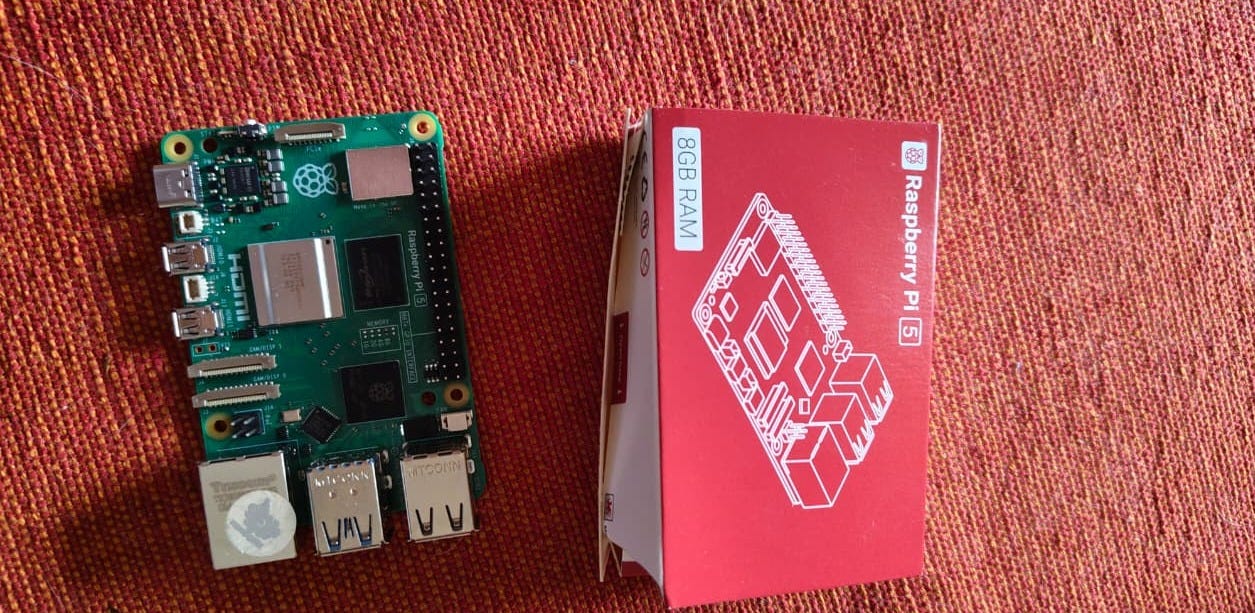
I later added a bot option that lets me message my Telegram bot to schedule a WhatsApp message.1 I can use natural language or a fixed format, and it will update my WhatsApp Scheduler. The bot processes my natural-language instructions using a local LLM (that runs offline on my Raspberry Pi)2, so I do not even spend any tokens for this.
The WhatsApp-Scheduler GitHub repo is available here.

3. WhatsApp CRM
Since I have my WhatsApp web logged in on the headless browser on RasPi, I thought it might be interesting to do a regular ‘content analysis.’ The WhatsApp-CRM scans my messages and, based on context, classifies contacts as personal, professional, or service. Excluding one-off transactional or service-based conversations, it surfaces:
Dormant chats: a nudge to connect with people I have not spoken to in a while.
Commitments: it reminds be about any commitments in the messages (e.g., “I will sign the lease agreement tomorrow”).
All categorisation of contacts, decision-making for nudges for dormant chats, and extraction of potential commitments happen locally on the RasPi offline.3 So, I do not have to pay for tokens, and my private messages stay on my device.
To be honest, I have not found it very useful. I rarely look at the CRM report, which I receive as an email each day and can also access in my browser at any time. I think I want to keep my social interactions ‘analog’ for now. The point of building it was just experimentation.
The GitHub Repo is available here.
4. Personal finance tracker
This is probably the most generic use case. There are many free apps to track spending: they typically require access to your messages and track spending based on bank transaction SMS messages.
I think it was Ashneer Grover who remarked that people actually do not want to know where they spend their money. Companies have tried various approaches, but take-up has been poor in India. Perhaps people’s revealed preference is to remain in denial about their spending. I am in that crowd.
I thought, maybe if I built my own tool, I would take more interest in tracking my personal finances. The second big advantage here is, again, that I do not have to give any third-party access to my messages or transaction details. My finance tracker also uses the local LLM on RasPi.
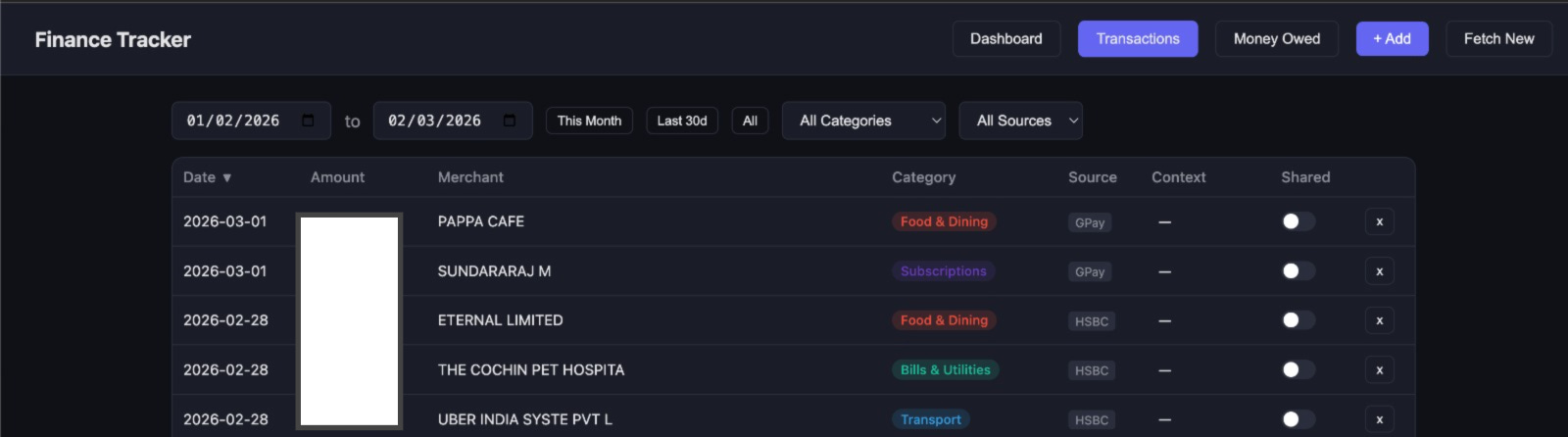
To my surprise, it is doing an incredible job. It brings together my expenses across different bank accounts and payment methods using bank update emails. It automatically categorises spending and adds context from the corresponding merchant emails. The cron job runs each night without any manual steps.
The GitHub Repo is available here.
5. Knowledge management system
This is currently a work in progress. I have long struggled with having a proper knowledge management system. I have tried various tools, but I eventually lose interest. As a result, my notes are scattered across Obsidian, Google Docs, Notion, WhatsApp messages to myself, Google Keep, physical notebooks, and various other places.
I am now trying to bring together all my existing notes into a single directory on the RasPi, which will be backed up each night to a private GitHub repo. Instead of sending myself WhatsApp messages, I have set up a Telegram bot for this purpose. It will automatically log my messages in the RasPi directory. In addition to text, it can parse images using a local OCR and can transcribe my voice notes with faster-whisper.
I can query my notes using the same Telegram bot, and it can answer my questions using the local LLM. It works decently, but not too well. I suspect the lightweight Llama 3.2:3B is not up to the task, and it will break once there are more notes in the directory.4 Further, each night, it tries to ‘analyse’ my notes and surface any interesting connections or ideas to potentially explore. I am yet to migrate my existing notes, hence this feature has not been useful so far. I have low expectations here.
The GitHub Repo is available here.
6. My personal research assistants
Finally, I have set up two agents, my research assisstants as an experiment. One is dedicated to research on my Kerala Growth Series, and the other is for my general interests.
These agents have ample context about my projects, my intellectual inclinations, some example preferred sources, and so on. They use Claude Sonnet 4.6 via API, because the RA job far exceeds the capabilities of the local LLM on my RasPi. The quality of research matters here, unlike a small miscategorisation on the personal finance tracker.

I am not sure whether this is any better than simply setting up a project on Claude. But the responses genuinely feel more tailored and high quality (confirmation bias?). Claude suggests that the quality will continue to be superior to projects, as agents will update their memory based on what I show interest in.
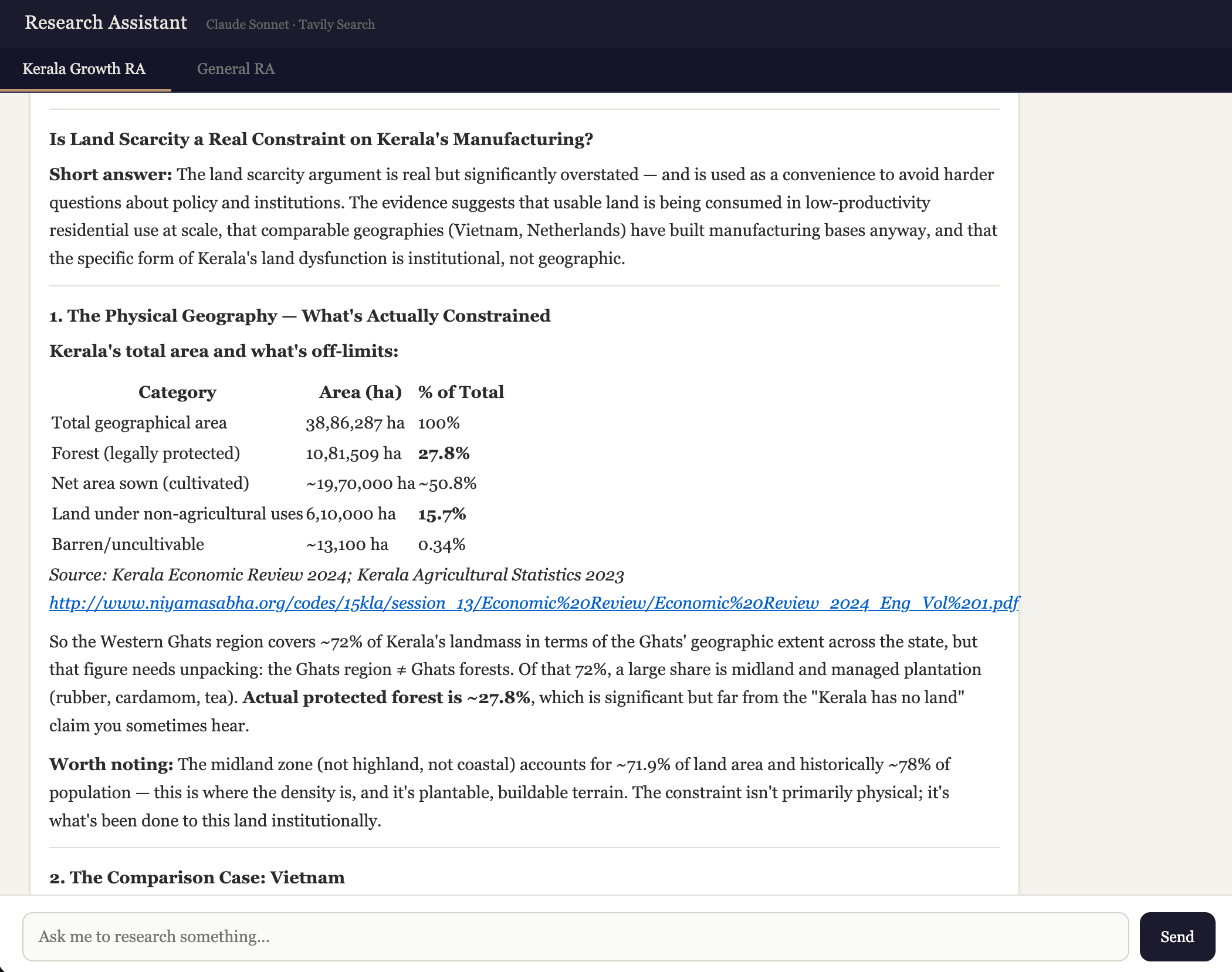
Unfortunately, it is quite token-intensive, and API usage costs are separate from my regular Claude Pro plan. So I will need to assess if these RAs are worth it.
Caveat
I think the obvious point to note here is that I am no expert in coding, and hence I am a poor judge of the quality of work. My reactions to policy research and writing done by LLMs are tempered by my ability to spot its weaknesses in this domain.
I suppose someone who is new to writing or research would be as awed by chatbots as I am by Claude Code. I suspect most of the coding it does is probably not very elegant and will not scale well. Yet, I think it is amazing because I am using the coding tools to build personal tools, so I do not need to worry about coding inefficiencies or cognitive decline.

A note on GitHub Repos linked in this piece: all of them are fully drafted by Claude Code itself. I think they are of fairly low quality and not very useful for humans. But I hope they are more legible for the AIs.
Other examples
I hope I have given you a decent flavour of the breadth of things for which one can use these agentic coding tools. Many use cases have nothing to do with coding. What I have been doing is fairly basic, not even close to the frontier of possibilities. For more inspiration, check out these two examples I recently encountered:
[Youtube video] Pranay Kotasthane, Khyati P and Saurabh Chandra discuss AI, showcasing how they use Claude Code.
[Website] Check out how Chris Blattman uses Claude Code for research on Claude Blattman.
Setting up Telegram bots is much simpler than WhatsApp (which does not natively provide that option and puts you at risk of being blocked).
I am currently using Llama 3.2:3B for this, which does a decent job. Qwen 3.5 came out yesterday, and I am planning to try it.
Ibid (see above)
I bring vibes 💅 he brings coding 👨💻
Thanks for this. I've always been interested but also intimidated by the coding world. Your POV make it feel like this world is accessible now, and gives me, a non coder, a license to at least try it out!