There are times when I cannot help but talk about politics. I mostly lost interest in party politics once I started working in policy. But, somewhere inside, I also self-censored because of toxicity, trolling, and literal physical risk.
If politics is a house, policy is the interior design that defines the quality of your life. It is the layout, furnishings, and aesthetics. Even the most magnificent palace is uncomfortable without a bed. But building the house still comes before doing the interiors. And when the house is on fire—when politics goes to hell—you cannot sidestep it to focus on the choice of curtains.
These protests evolved far beyond the paper leak in the National Eligibility cum Entrance Test (NEET) and became a platform for expressing general frustration. I do not see much value in them providing ‘solutions’ to the state of education. Their biggest contribution instead has been to put a dent in a prevailing environment of fear and break the spell of political irreproachability (here is my earlier thread).1
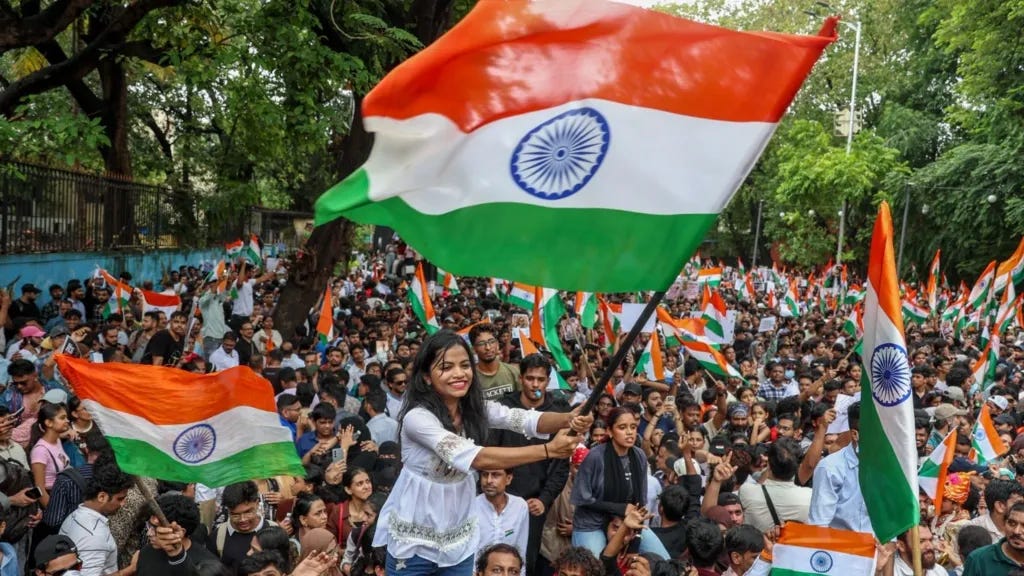
The protests provided an outlet for pent-up frustration from constant micro-censoring (often self-censorship). The constant vindictiveness against any remotely critical statement, an off-the-cuff remark in an interview, a social media post, a movie, or a web series has all been too suffocating.
Venting freely acts as a pressure-releasing valve. But over the last decade or so, the government tried to block the whistle of the pressure cooker while letting it simmer. This was a much-needed release, and I hope the environment (mahaul) gets recalibrated for the better.2
The Education Minister's resignation is a small sacrifice for the Modi government. He might have been dropped from the cabinet in a ‘routine’ shuffle anyway. The key difference is that the NDA would have wanted to do it on their own terms. Which is precisely why the forced resignation matters, as the government had to swallow its ego.
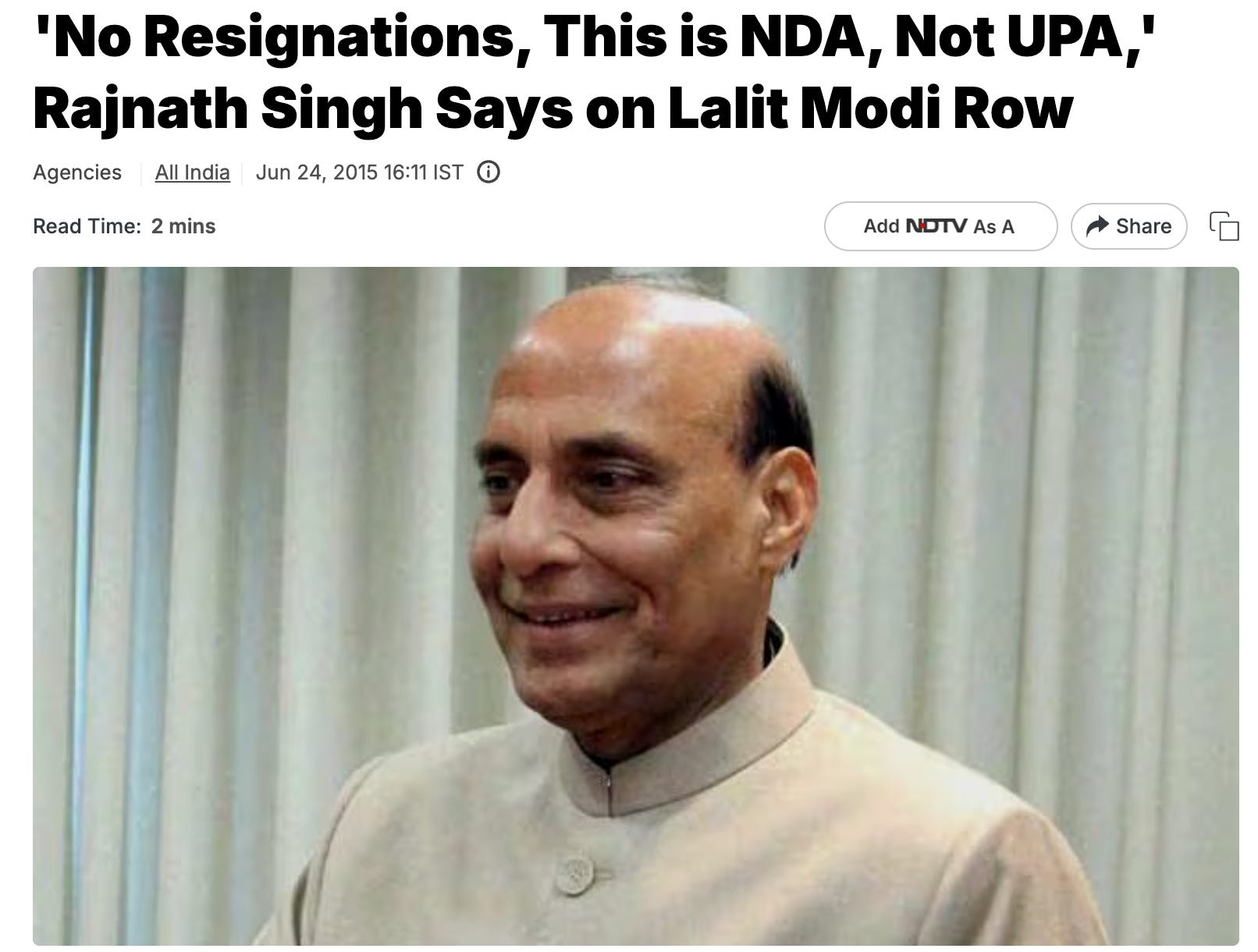
Rajnath Singh had proudly claimed that resignations do not happen under this government. Indeed, Modi had never sacked a minister under duress in the last 25 years. It is perhaps the first major successful mobilisation of citizens beyond a specific religion, caste, or interest group (e.g., farmers), and the usual government rhetoric of foreign-hand involvement fell flat.
Anatomy of the social media hivemind
A lot of credit goes to creators on Instagram who have pushed the boundaries of freedom with humour, one reel at a time. It is surprising, given the outrage it tends to cause elsewhere, how common satire involving the Prime Minister has been on Instagram for a while. Perhaps because of a filter bubble, this type of content did not proliferate outside in popular media or even on other social media platforms.
One distinctive feature of Instagram humour is the amount of context it carries. The language and references are often illegible to others. This is conceptually different from the usual view of social media as ephemeral content. Instead, reels and memes create a thick culture, a shared bottom-up vocabulary. They build on one another, sometimes over years.3 We now have wastegunahuiya and kuchu puchu being mentioned in parliament.
Consider the communication style of Gen Z reels. The “bro did not hesitate” memes show people saying out loud some of the intrusive thoughts that occur in our heads but are considered too socially unacceptable or impolite. Similarly, “bakch*di nahi rukni chahiye” or “masti nahi rukni chahiye” memes are about focusing on the humour in the worst of circumstances.
These trends are all fun and games on the surface. But they carry an implicit contempt for authority and restrictions. They challenge the boundaries of what is socially acceptable or sanctioned by self-proclaimed guardians of sanskaar. It is a great thing to happen in a conformist society like ours.4 This is why people are referring to them as the “most unserious serious generation.”
Multiverse of hiveminds
These protests also created a positive feedback loop between creators, who are mini-celebrities, and their audiences. When unexpected people showed up at Jantar Mantar, there were reels about “hackers entering the lobby”, which prompted more participation.5
People like Rajiv Talwar use a language that will probably get you a beating if played aloud at home. But they get across their message because of their rawness. They did not invent cursing; it is how people often talk in private. They only broke the pretence of sophistication in public settings.6
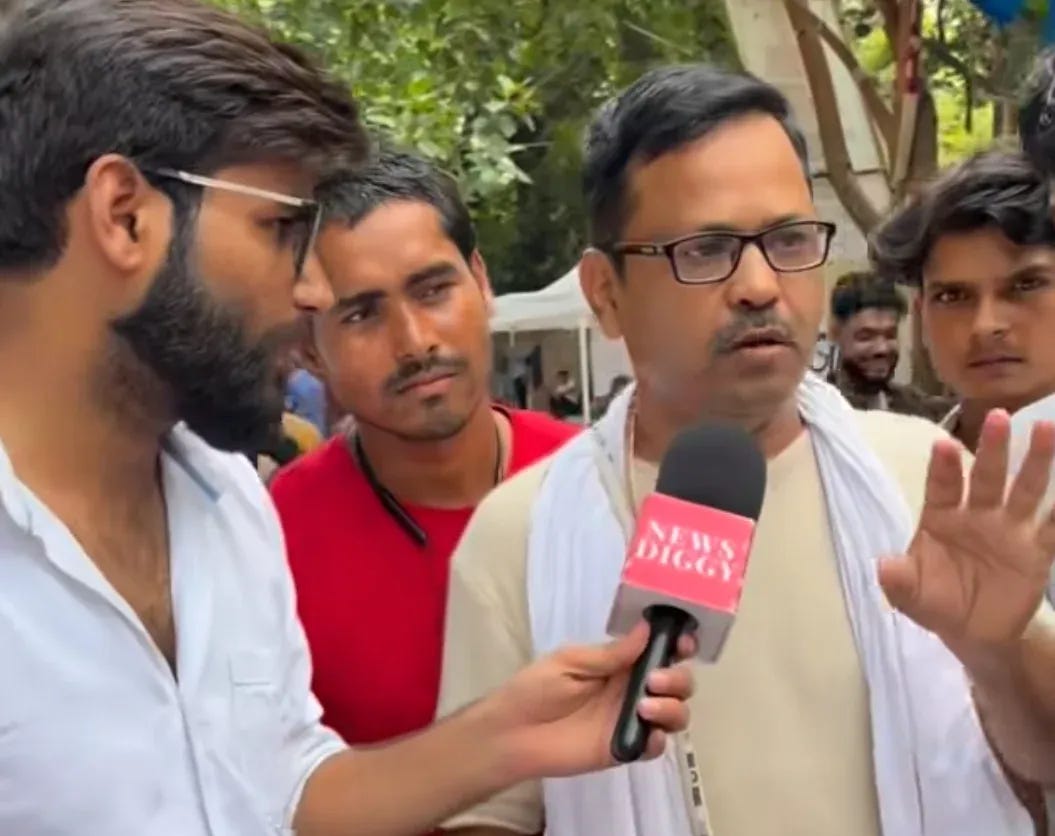
These creators have a fan base. Even when it is ironic, fandom is true. Many of them make content that has nothing to do with politics. But when I see literal meme templates walking around at Jantar Mantar, I want to be there too (if nothing, then just for the lolz).
For the creators, these offline collaborations meant more content and views. For the audience, it meant more entertainment and an opportunity to see these celebrities from disparate worlds come together.7 It is like watching Nusrat Fateh Ali Khan perform with Dua Lipa.
A new politically relevant identity?
A few months ago, I was telling a friend that the category "Gen Z" in India is nonsensical. What I meant is that most people identify with their immediate community far more than their generational peers. An 18-year-old boy is closer in political orientation to a 55-year-old uncle of the same caste than to a fellow 18-year-old girl from a different caste stratum. This might be true, but I was at least partly wrong.
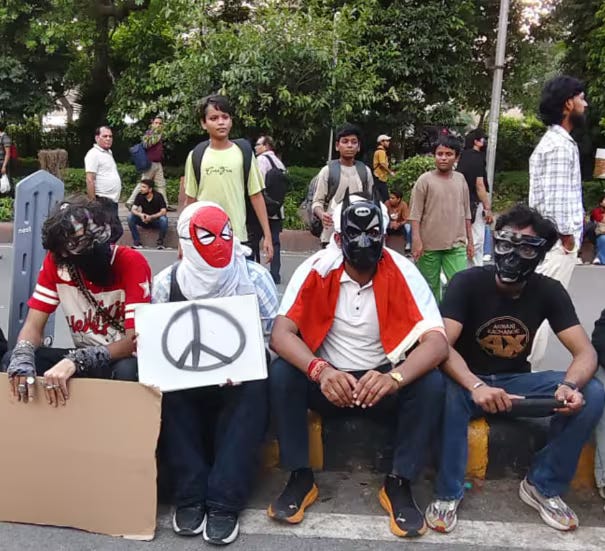
During these protests, I noticed the Gen Z identity being concretised and reinforced in real time. Outsiders, including the news media and politicians, referred to the innovative protesters as Gen Z, who then adopted the label. “Gen Z” seems more specific and sticky as a category than “youth”. There may be norms developing around what is cool or high status among Gen Z.8
Where CJP & co played smartly
I see much criticism of the ‘naivety’ of the Cockroach Janta Party (CJP) and its ‘minimalist’ demands. These tend to make a category error in evaluating CJP as a political party, which is better understood as a satirical social media initiative that became a pressure group.
Abhijit Dipke did not have to come from America based on social media fanfare. Sonam Wangchuk, Neha Bora, and others did not have to fast. Instead of being grateful for their grit, many lament about not getting a ‘revolution’ out of these protests.9 It takes wisdom to know when to take a win and call it a day when you are on a high.
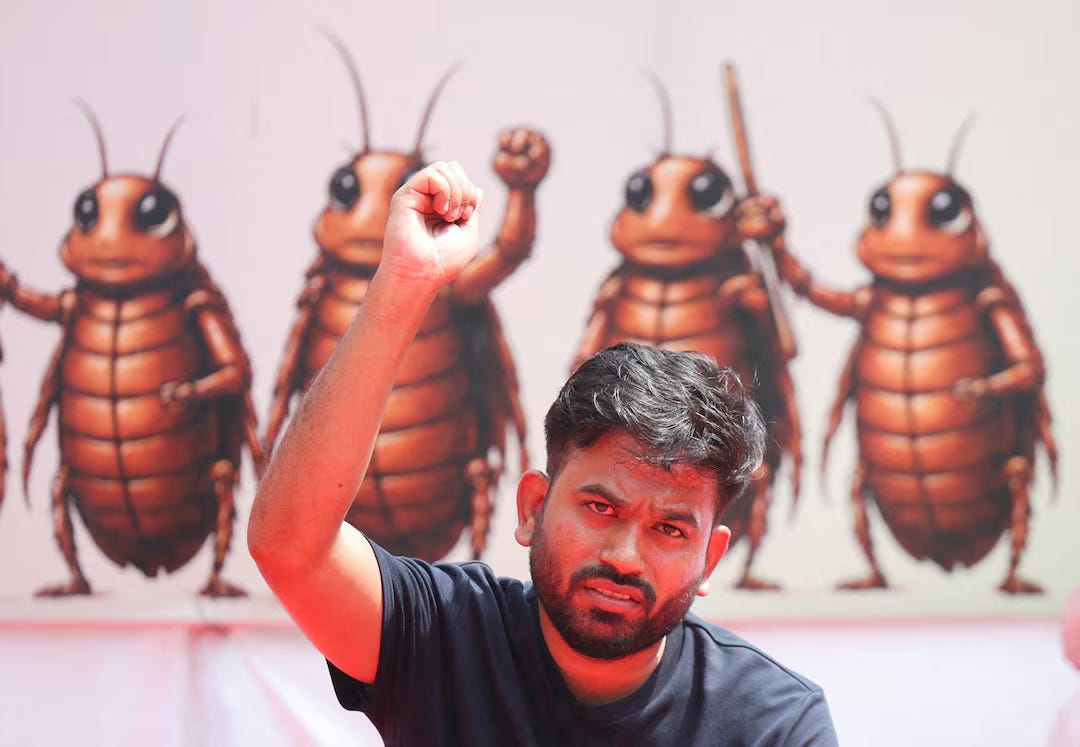
I admire the CJP team for staying the course for weeks despite being written off. I was one of the cynics as I did not expect the Instagram generation to step out (aka do something “IRL”). For a change, even opposition parties did well by supporting the protesters without fully taking over.10
As a pressure group, CJP’s approach worked precisely because they were so minimalist. Fence-sitters felt like these were very basic demands and nothing ‘revolutionary’. They slowly expanded the political overton window, which is the range of political views that are acceptable to be expressed in a public setting. They made criticising the Prime Minister, publicly and loudly, normal again.
Brace for the impact
In both policy and politics, the good news tends to be followed by some sobering qualifications. So here we are. This has been a meaningful but small win. There is no guarantee of its expansion or even stickiness.
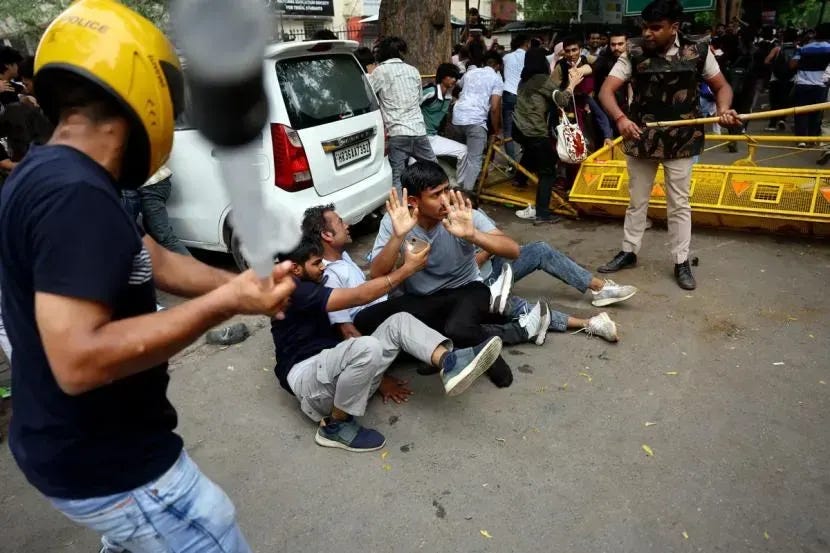
The single-biggest win of these protests has been to make criticising the government normal, and even cool. It has lifted a veneer of fear. But it would be a mistake to think of Gen Z as homogeneously as these protests might suggest.
The BJP is not the one to give up easily. Their first order of priority is to stop the contagion of criticism. The government machinery is working to scrub critical posts under the guise of “derogatory, malicious and defamatory content.” The social media takedowns will likely backfire due to the Streisand effect.
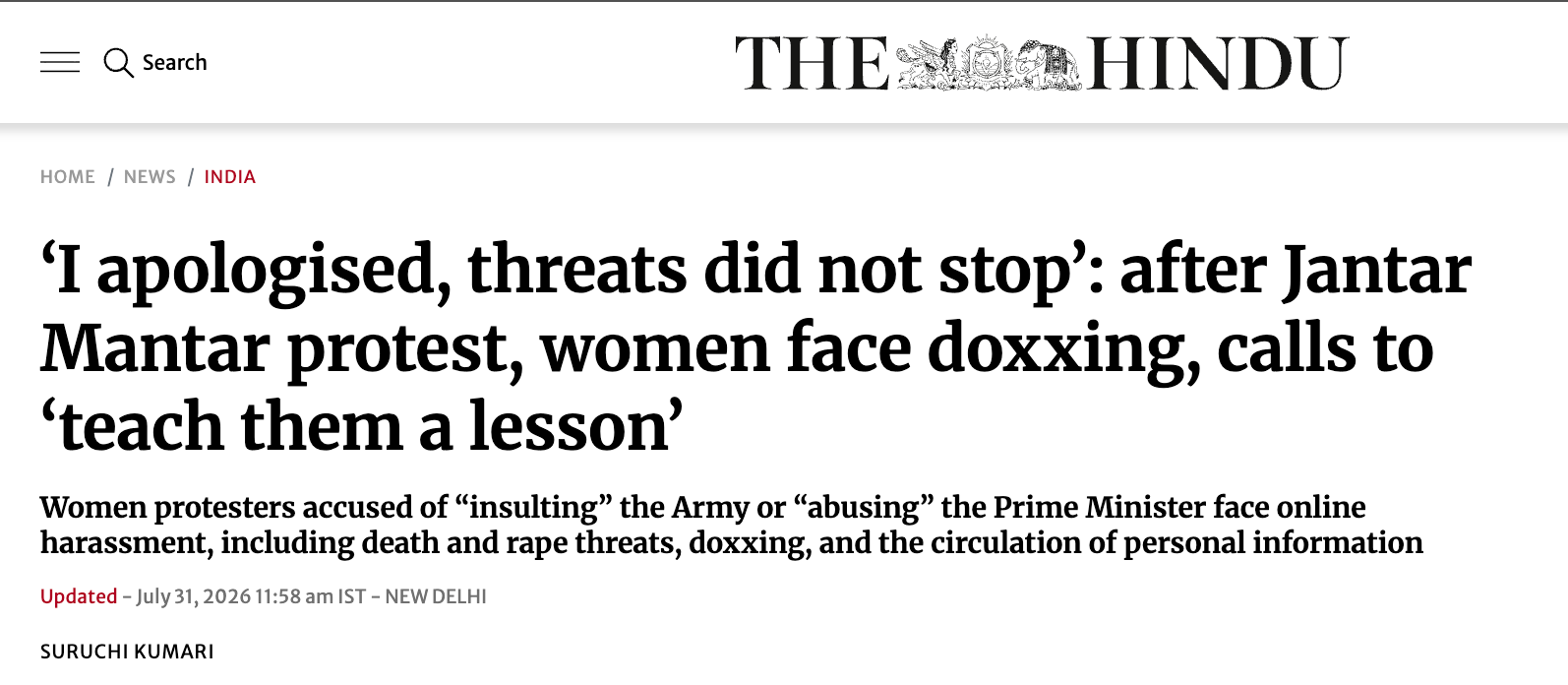
The NDA governments and their allied machinery are trying to restore the chilling effect by making a few examples. Hence, there is police action against protestors11; government supporters are doxing young girls for profanity against the Prime Minister12; vigilante groups harassing and beating up some supposed protesters or their sympathisers on video, and so on.
These protests have created an opening. It has given organised political forces enough fodder to take on the incumbent. We should not expect regular students to do the job of an organised political opposition. As citizens, we need to show a little more courage in exercising—and thereby protecting—our freedom of expression. That is the best way to defeat efforts to restore the chilling effect.
The incumbent's authoritarian tendency is an immediate problem. But a much deeper problem is the design of the Indian state itself.13 The police forces act with vengeance on a political cue. But they usually do not know any better than their original role, which was dealing with colonial subjects instead of serving citizens. We cannot lose sight of confronting and reforming what makes our institutions so easily susceptible to political interference.
Further reading and watching
[Indian Express] P B Mehta writes: ‘Cockroaches’ have shown us what it means to be courageous citizens — not subjects (open access available here)
[Unfiltered by Samdish | YouTube] Ye Hua Tha 20 July 2026 Ko
[Hindustan Times] ‘Kuchupuchu, resign kar do’: No lengthy speeches, GenZ are redefining language of protest with memes, sarcasm & costumes
[BBC] CJP protest: The youth movement India’s Modi didn’t see coming
[The Print] PM Modi and BJP should thank cockroaches. They have done them a lot of good
[NYT] Phones in Hand, India’s Young Protesters Blast Through Modi’s Media Control
In a way, the protests may have contributed to a preference cascade, a “widespread shift in public opinion that occurs when people suddenly stop hiding their true beliefs and begin expressing them openly.” Since there is always confusion about how much support the government actually enjoys among voters, people who are mildly critical may hesitate to ‘waste’ their vote on others. Over the last decade, criticising the government on a public platform became rarer. But once you see others doing it, it becomes more acceptable. Now even Tanmay Bhat seems more comfortable making jokes about the government, after mostly steering clear over the last few years. There is more freedom in the air.
This is probably wishful thinking, but I hope it makes people more suspicious of the state in general… irrespective of who is in power.
I used to agree with Amit Varma’s suggestion that the collapse of the mainstream would mean that the new generation would not have common cultural references (as people would be divided into smaller and smaller niches based on their information diet mediated by algorithms). But I do not see that happening, and memes have created an alternate world of cultural references.
Sometimes this will result in genuinely problematic speech. That is an inevitable part of free speech, and those are best addressed in the comments section.
Niche references are described as “only those with 5+ hours of screentime will understand this.”
Varun Grover says: “Cuss words are no longer the underground culture they were a decade ago. (Even Gangs of Wasseypur was like 14 years ago.)… Access to international rap, desi hip hop, more than 100 Indian comedians not censoring their language, even when they censor their thoughts, and in some cases political patronage to the cuss-heavy influencers have made sure that the language on the street is no more purist/sanitised. The more it shocks the authority figures, the more it will be used…. An aura - carefully built over a decade - took a fortnight to burst into smithereens. That’s how flimsy it was.”
Also, ‘creator’ and ‘audience’ are not fixed roles. A very large portion of Gen Z seem to be both.
Varun Grover says, “Today - watching news TV is seen as one of the most uncool, low IQ things by a majority of the population.” I am sceptical about the “majority of the population” part, but it seems true for very young people. The further irrelevancy of the compromised mainstream media is good, even as there are serious problems with replacements. For example, social media can create algorithmic bubbles and alt media is susceptible to audience capture.
Revolutions generally suck; marginal progress is highly underrated.
Minus the usual bickering between the Aam Aadmi Party and Congress.
Apparently, a Kishangarh native who claims to be living in Russia for the last four months has been booked by the police for mischief during the protest against the NEET paper leak in Bihar.
Now a case has also been registered. The verbal ‘abuses’ made the Prime Minister like any other elected representative. These actions are an attempt to restore his stature as a sacred supreme leader, a Khomeini equivalent.
Also check out the following Everything is Everything episodes: Why Freedom Matters; Understanding the State; Public Choice Theory Explains SO MUCH; The Long Road to Change; Don’t Run a Country Like a Company; Why I Am a Free Speech Absolutist; Rules, Not Discretion; Is Your State Legitimate?