#37: Ambition and optimism
Part 2 of notes from Emergent Ventures meet-up
Continuing with the theme of the previous post, here is more about my experience at the Emergent Ventures meet.
Previous post (part 1):

I generally do not enjoy large meet-ups. At best, I am only moderately social. But this crowd was different. While it was socially draining at times, much of it was fascinating, fun, and inspiring. The median person I spoke to felt less performative compared to a typical gathering. There was little small talk, and people spoke passionately about their moonshot ideas. More than anything, I found the ambition in each of these projects most inspiring.

In a recent conversation, David Brooks talks about the decline of audacity in literature. I feel this is a broader phenomenon, also seen in philanthropy. Many projects are incremental and measurement-oriented, often suffering from a confusion of ends and means. The EV meet-up was a refreshing change. Below, I share a small sample of what I heard from the people I met.
I
I will start with some familiar faces. I introduced myself to the great Amit Varma, who hosts my favourite podcast, the Seen and the Unseen. Soon after, I met Pranay Kotasthane of the Takshashila Institution, who also co-writes my favourite thoughtletter, Anticipating the Unintended. The two have had a profound intellectual influence on me. Many of my current first principles, directly or indirectly, trace back to them. So, it was very much a fanboy moment for me.
I was pleasantly surprised when Amit and Pranay recognised me by name from our few online exchanges. Of course, this says more about them than me, as I am sure they receive hundreds of such messages. Later, I met Khyati and Saurabh, who co-host the Puliyabaazi podcast with Pranay, featuring policy discussions in Hindi. I also met my Twitter acquaintance, Akash Kumar, not realising until then that he was an EV grantee.
I was amazed at Shruti Rajagopalan’s ability to remember the names, projects, and the surrounding context of 150+ people, even as she met many of us for the first time (she leads EV India and was the co-organiser). I think this quality of being so authentically interested helps in talent spotting.
II
While I was in the dinner buffet line, I overheard someone mention Works in Progress magazine. I started following their work a couple of months ago. I am a big fan of their research and aesthetic taste, in addition to the content quality. I discovered that the person behind me was Saloni Dattani, the magazine’s co-founder! Again, I did not even know this began as an EV project. We talked about how the magazine operates and her new podcast, Hard Drugs. She was extremely forthcoming and patient in answering questions.

I learnt about Veeraa from Ronald Abraham, which is a crowdfunding and growth platform for India’s community leaders. They aim to platform and support 10,000 vetted community leaders in the next 10 years. I have known Ron as the co-founder of my current workplace. He stepped away from IDinsight in 2022 to do new things.
I found a perfect match in Anand S Unni, who works in the policy space in Kerala. He runs the Nayaneethi Policy Collective, a Kochi-based think-do-tank. This was music to my ears, and I see great potential for collaboration on my Kerala series. Among the few other bloggers/substackers in the group was Hiya Jain, who writes Mundane Beauty. I learnt about the Roots of Progress fellowship from her.
III
The meet-up followed an unconference format, which means that “the agenda is created by the attendees at the beginning of the meeting. Anyone who wants to initiate a discussion on a topic can claim a time and a space.” Some unconference sessions are led by the participant who suggested the topic; others are open discussions of the session topic.
In one session, Khyati, Saurabh, and Pranay talked about the ambition and challenges of building a Hindi vocabulary for policy discourse. The problem is that when there are no familiar words for critical economic concepts, those ideas are harder and less likely to be discussed. It is a vicious cycle: if these ideas are not discussed in the language, the relevant terminology and frameworks do not get developed. As a result, the discourse gets stuck in a lower-level equilibrium. Language is scaffolding for ideas.
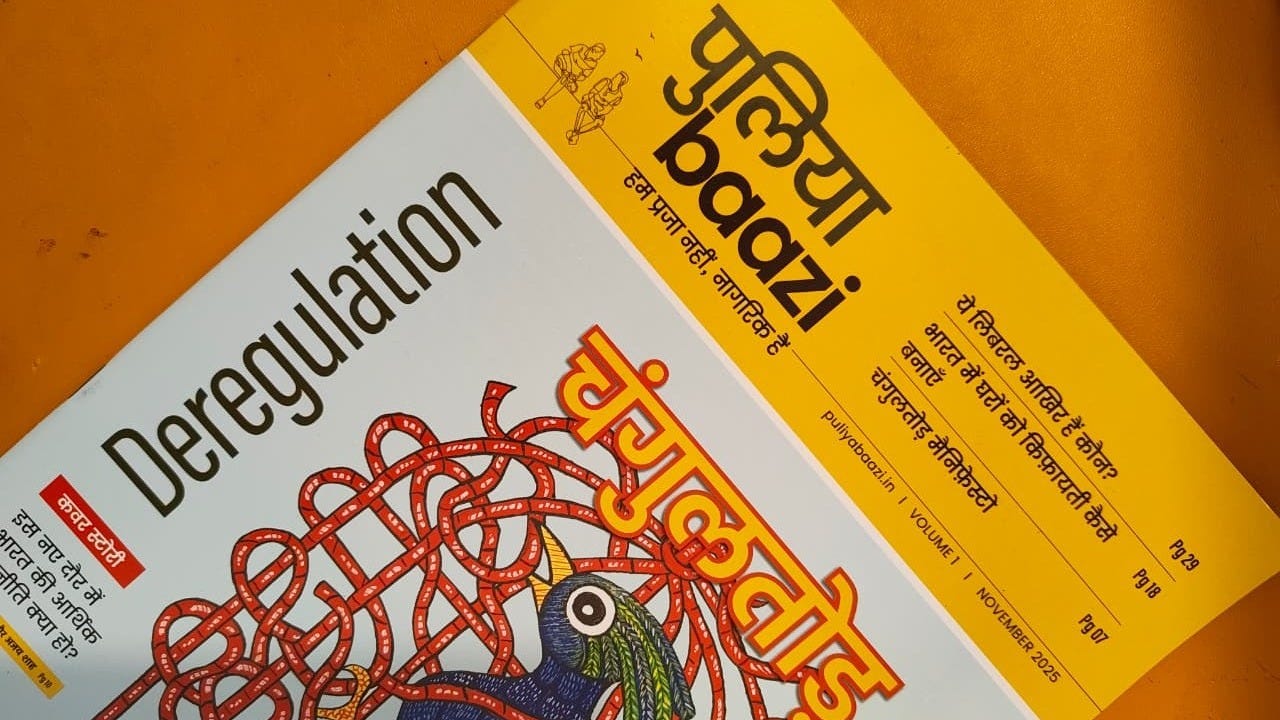
Puliyabaazi has taken up the herculean task of breaking that cycle. The co-hosts put themselves on the spot to discuss policy ideas in Hindi, which encourages them to develop a new vocabulary creatively. There are interesting trade-offs. The technical terms in English carry histories and associated ideas that a new Hindi term would lack. On the other hand, a literal translation of English terms sounds stilted and is unlikely to stick. Here is a sample of the kinds of challenges they face.
There was another session on podcasting, in which I heard many familiar podcast voices in one room: Shruti Rajagoapal (Ideas of India), Tyler Cowen (Conversations with Tyler), Amit Varma (TSATU), Khyati, Saurabh & Pranay (Puliyabaazi), Saloni (Hard Drugs), and Divyanshu Dembi (Jack of All Knowledge). It felt like a surreal crossover of some of my favourite podcasters, albeit at an unfamiliar 1x playback speed.

IV
In an uncanny coincidence, the first conference participant I met was Mohd Fahad Eqbal. Finding my name-fellow is a rare occurrence. We happened to have taken the same flight and met at the airport. He is the founder of Chakra Swap, which is developing India’s only battery-swapping station network tailored exclusively for the L3 category (e-rickshaws). This increases drivers' earning potential, eliminates battery replacement costs, and helps the environment through efficiencies of large-scale operations and recycling. Total win-win-win.
I also learnt about Wimgrow Market, a marketplace that enables marginal farmers to sell their produce directly to consumers. They streamline transportation and marketing, giving farmers access to a larger market and better prices outside the Agricultural Produce Market Committee (APMC) markets.
Rain Regious, an undergraduate student at the University of Delhi, highlighted a simple fact: we are all standing in a large auditorium, but the collective volume of humans is less than 1%. Yet, we cool (or heat) the entire volume for our comfort. What if we could adjust the human bodies instead?
Rain is exploring a non-invasive body-computer interface to broaden the human body’s thermoneutral zone, the ambient temperature range where we stay comfortable without the extra effort. I understood it as a ‘thermostat for the body.’ Excellent out-of-the-box thinking.

There was a wide range. I met Soni Wadhwa, who is building a digital archive of post-partition Sindhi literature in India. At the same time, I also met someone working on a breath-based, non-invasive glucose test; someone building hybrid commercial vehicles for India; someone working at the intersection of AI and Gene Editing to overcome the limitations of CRISPR; and heard about several ambitious aeronautical projects.
This is a tiny sample of the many ambitious and interesting things I came across, but I hope you got a flavour. You can check out Tyler Cowen’s most recent announcement of EV India winners — there are links to access previous announcements at the bottom. I hope this inspires more funders to be bolder.